
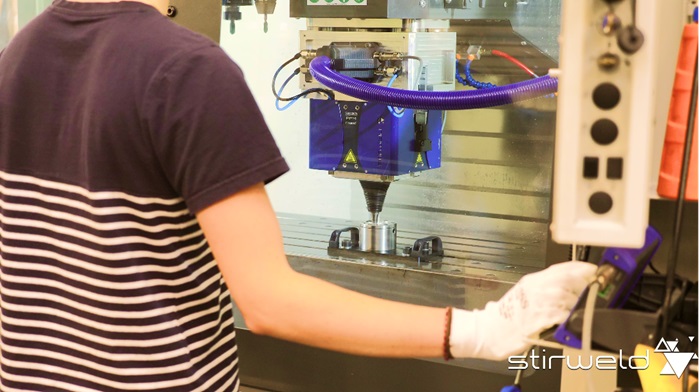
Friction stir welding (FSW) has now emerged as a revolutionary process in manufacturing because it provides a competent, tough and efficient route in joining metals. FSW was invented in 1992 at the The Welding Institute, and over the years has spread across different industries, more significantly in aerospace, automobile, rail, and ship industries. The process is free from many problems associated with such fusion welding methods and is preferred for joining components with high strength materials such as aluminum. Here, we’ll review the basics of FSW, the advantages and the industries that use it.
Understanding the Process of Friction Stir Welding
At its core, friction stir welding works by utilizing a rotating tool that moves along the joint between two metal pieces. As the tool rotates and moves forward, it generates frictional heat at the weld seam, causing the material to soften (or “plasticize”) without actually melting. This heated, plasticized material then fuses under pressure, creating a solid-state bond. This is a significant departure from traditional welding, which relies on melting both materials to form a joint, often leading to defects such as porosity and cracking.
The solid-state nature of FSW makes it suitable for joining high-strength aluminum alloys, as well as dissimilar materials, with minimal post-weld distortion. The entire process is precise and controlled, resulting in strong, defect-free joints that meet stringent industry standards.
Superior Strength and Durability
It is for this reason that FSW is widely preferred, as a result of the high strength and weld quality that it yields. In contrast to other welding processes that create defects, for example, porosity, cracking, and distortion, FSW has relatively few of them. This is particularly important in performance-orientated applications where weld quality is directly related to durability and safety. Due to the ability to make extraordinarily strong joints and withstand fatigue FSW is perfect for transport industry applications such as Airplane structures and automotive frames.
Fatigue and stress resistance of FSW welds is also high, which allows using them for products that require repetitive use. This is particularly strategic in sectors such as rail and Marine transport since equipment is under constant stress and will require durability for a long term.
Enhanced Safety and Eco-Friendliness
Environmental and safety aspects are also evidenced at friction stir welding. Included in the process is no melting therefore no toxic fumes, molten splatter or dangerous radiation is emitted. It goes without saying that the mentioned process enhances the safety of operators at the workplace; the chances of operators contracting diseases are far much lower than those of employees using conventional welding techniques. FSW machinery can therefore be safely observed with lot of complains and safety equipments can be avoided.
Furthermore, FSW does not require any filler materials and no shielding gases as are used in fusion welding. In the context of sensibility to the environment, through not including these extra materials, FSW cuts back on manufacturing cost. This is in line with the increased importance the world is placing on sustainable production processes in industries as firms work towards minimizing wastes as well as emissions.
High Efficiency and Cost Savings
Another key benefit friction stir welding is that is efficient in terms of its use of material and energy. Due to its capacity to be carried out automatically it is therefore best suited to organizations that produce an above-average rate of products. For instance, in the automotive segment, automotive makers depend on FSW for parts such as the battery boxes of electric cars because high velocities and excellent quality are crucial in such applications. The automation aspect not only helps FSW to be faster but also cheaper since most of the work is done by machines and not by people hence can hardly be affected by defective products which would actually call for more manufacturing.
Further, FSW yields high-quality, clean welds with minimal surface roughness, although subsequent polishing may still be necessary in some cases while they add no excess material cost to the component. Besides being time-saving and increasing production that cuts on costs this particular feature is highly suitable for industries requiring high levels of accuracy and surface appearance.
Versatility Across Metals and Applications
FSW is the only process that allows for a direct joining of aluminum but also metals such as copper and some types of steel. It can also bond dissimilar materials, which is particularly difficult to achieve with most common fusion welding processes.
For these reasons FSW is a vital tool in the transportation industry where material offers a need for strength as well as light weight. For example, high-strength aluminium alloys that are widely employed in aircraft application cannot be welded easily using fusion techniques because of the tendency of these materials to crack when in the solidified state. These alloys can be welded reliably to each other by FSW, thus opening a possibility for constructing lighter and safer aircraft structures.
Its capacity to weld different kinds of materials also expands the technology set of uses such as in the battery technology and renewable energy, whereby dissimilar types of metals need to be bonded perfectly without compromising on their durability.
Key Applications: Aerospace, Automotive, and Beyond
The impact of FSW is perhaps most notable in aerospace, where every gram of weight saved contributes to improved fuel efficiency and range. FSW allows manufacturers to replace traditional riveting techniques, which are heavier and prone to corrosion. By reducing the number of rivets required, FSW not only cuts down on overall weight but also enhances the structural integrity of components, extending their lifespan. Notably, SpaceX has adopted FSW for manufacturing fuel tanks in its Falcon 9 rockets, taking advantage of FSW’s ability to provide airtight, high-strength welds essential for withstanding high pressure.
In the automotive industry, companies like Tesla and Honda use FSW to create battery enclosures for electric vehicles. The process allows them to produce durable, lightweight enclosures that improve battery efficiency and vehicle range. Similarly, FSW’s application in rail and marine industries highlights its versatility; whether it’s welding aluminum train roofs or ship hulls, FSW offers a strong, corrosion-resistant solution that reduces maintenance and extends product life.
The Future of Friction Stir Welding
If industries remain concerned with strength, functionality, and durability, then FSW’s use will continue to rise. It is becoming even more useful in advanced manufacturing because technologies are broadening the range of materials and alloys to which it can be applied. As the evidence of its efficiency in decreasing the costs and improving the safety and durability of products, FSW promises to stay a key technology in a wide range of demanding applications.
In conclusion, what sets FSW is on the fact that it can produce sound, defect free weld in materials that would ordinarily be difficult to join. As a safety system, it is suitable for use in environments and applications that require finger protection elements to be durable with a lightweight construction; that are efficient, for hazard preventative functions, with low environmental impact. Hence, through addressing these core needs, FSW is building tomorrow’s better, stronger, sustainable, and performance tailored manufacturing industries in different sectors.
 Business News Blog